
Amid escalation in violence in a number of Gulf countries, India on Thursday expressed deep concern over the rise of fanaticism, extremism and terrorism in parts of the Arab region, saying they are tearing apart the fabric of societies as well as affecting regional stability.

The two countries also asked all nations to stop cross-border movement of terrorists and asserted that a decisive collective response from the international community without 'double standards and selectivity' was required to combat the threat of terrorism.

Tillerson said China's behaviour and action is "posing a challenge to the rules-based international order".
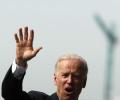
United States Vice President Joe Biden on Monday left for a rare vice presidential trip to India for the first leg of his visit to the Asia-Pacific region.
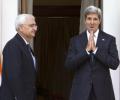
The United States on Monday assured India that its concerns over Taliban insurgents gaining legitimacy without severing their terror links will neither be "overlooked or undermined" during the talks with the Islamic fundamentalist group.

'In Chinese perception, India is strategically getting closer to United States and some Chinese analysts fear perhaps one day it may become a part of American arrangements against China.'

'Notwithstanding the realisation among the Indian leadership to build up its navy for the force's expanding role, the Indian Navy was allocated only 15% of the interim defence budget presented in Parliament in February 2019.' 'The outlay for the navy's capital acquisition is not even adequate to meet its committed liabilities,' points out Brigadier S K Chatterji (retd).

'How can Kashmir be demilitarised if the terrorist threat remains and Pakistan continues to incite elements in Kashmir to keep the internal situation unstable?' asks former foreign secretary Kanwal Sibal.

'Xi Jinping got a dose of Modi's medicine inside the tent where he was being hosted on the banks of the Sabarmati river.' 'Modi reportedly told him, looking deep into his eyes: "This was not expected of your country. Can you tell me when the troops are withdrawing?".'

'If the US-Pakistan relationship continues to suffer, Pakistan may feel it has less to lose and decide that it need not keep a leash on LeT in order to appease America.' 'A tougher US policy toward Pakistan could lead to an emboldened and strengthened LeT and JeM, resulting in more terrorist attacks in India.'
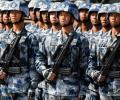
While China's nationalistic tabloid Global Times said India should be taught a 'bitter lesson', another official newspaper, China Daily, said India should look in the mirror.
.jpg)
Climate change and US-India collaborations in renewable energy resources will be up for discussion at the US-India energy summit coinciding with Prime Minister Narendra Modi's visit to Washington, DC, later this month, reports Aziz Haniffa.

Since the 1984 national elections, no party has won a clear majority in the lower house of Parliament, a US intelligence report has observed. Vicky Nanjappa reports.

As India strives to make its Act East Policy a comprehensive politico-diplomatic and economic success, Brunei gains more salience, says Dr Rahul Mishra.

External Affairs Minister Sushma Swaraj, who held extensive talks with Egyptian leadership on Monday, proposed to step up exchange of information and coordination to combat terrorism, both at the regional as well as global level

'One lesson to emerge out of the Modi-Putin summit is that India can be more self-confident that it possesses inherent strengths to leverage its interlocutors to influence Pakistani policies,' says Ambassador M K Bhadrakumar.
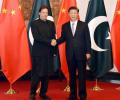
'The scheduling of Imran Khan's visit to Beijing and its focus on the J&K situation underscores that Beijing shares the Pakistani concern that tensions with India are only going to escalate further in the period ahead,' says Ambassador M K Bhadrakumar.

'We use the word "historic" perhaps too much, but the prime minister's visit certainly was historic in so many ways.'

During their talks, the two leaders decided to significantly expand their ties in several key areas including defence, trade, energy and education.
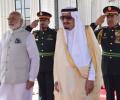
India's ties with Saudi Arabia have been on an upswing over the last two decades based on burgeoning energy ties. Both sides are keen on expanding the economic ties in a range of areas besides the oil sector.

US Ambassador Richard Verma's tips to the Indian states.
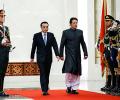
'Imran cannot escape responsibility for providing a mask to the Pakistan army to engage in unlawful activities and to wage aggression after India retaliated to the terrorist attack,' says Ambassador T P Sreenivasan.

India's decision to skip the meeting came after a year of bilateral discord over China's stubborn opposition to India's entry into the Nuclear Suppliers' Group and a UN ban against Pakistan-based terrorist group Jaish-e-Mohammed leader Masood Azhar.
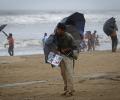
India is likely to announce its targets for the Paris deal by September-end.

Following is the full text of Prime Minister Manmohan Singh's speech at the Central Party School in Beijing on Thursday:
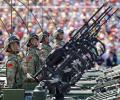
'Whether it is the One Belt One Road project or building relationships in the Indian Ocean Region -- supposedly our area of concern -- the Chinese are seriously outpacing us,' points out Vice-Admiral Premvir Das (retd).

'China refuses to talk to India on nuclear or ballistic missile issues and conclude any de-targeting agreement as Beijing did with Russia or a non-targeting agreement with the US.'

India and China on Wednesday signed in all nine agreements, including the Border Defence Cooperation Agreement and one on strengthening cooperation on trans-border rivers, after restricted and delegation-level talks that lasted over two hours as Prime Minister Manmohan Singh and Premier Li Keqiang met for the second time this year for talks which the Indian leader described as "fruitful and productive".
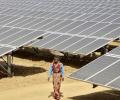
Arunabha Ghosh on why India will increasingly become an energy great power, but not an energy hegemon.

Trade between India and Indonesia stands at $20 billion.

What will a BJP government in New Delhi mean for Washington? Four senior US officials who served in the Clinton administration during the NDA government, offer their perspective, says Aziz Haniffa.

Prime Minister Narendra Modi enjoys a close relationship with Shinzo Abe. For Abe, "a strong India is in the best interest of Japan, and a strong Japan is in the best interest of India."
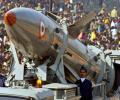
It is time the new government, unencumbered with the burden of past, initiates a wide ranging review and open debate on the security issues to rectify our short term and long term shortcomings. It has taken some wise steps but has to go beyond this to identify the structural weakness and create systems, says Colonel (retd) Anil Athale.


'Xi Jinping is keen that the second Trump-Kim summit happens soonest.' 'Kim is reported to have told Xi that he expects to achieve a result from a second summit that the international community would welcome,' points out Dr Rajaram Panda.
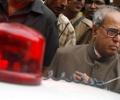
Coming down heavily on Pakistan, President Pranab Mukherjee has said unless it dismantles the terror infrastructure on its soil, there is no scope for progress in talks between the two countries.

Fresh from his maiden trip to Afghanistan, Democratic Congressman Ami Bera, the only Indian-American lawmaker in the Congress, has said that India has a very critical role to play in peace and development in the war-torn country.
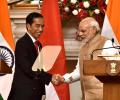
The two countries, among the very few fast growing large economies globally, also decided to boost bilateral trade and investment in areas of oil and gas, renewable energy, IT and pharmaceuticals, during talks between Prime Minister Narendra Modi and Indonesian President Joko Widodo.
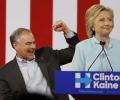
Rediff.com reproduces this 2014 interview with Tim Kaine where in he discusses the new opportunities to foster Indo-US trade and the improvement in ties.
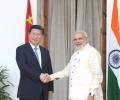
With the continuing stand-off in Ladakh casting a shadow over the Sino-India talks, Prime Minister Narendra Modi on Thursday raised 'serious concerns' over the repeated incidents along the border and sought an early settlement of the boundary question.
 © 2026 Rediff.com - Advertise with us - Disclaimer - Privacy Policy - Sitemap - Feedback - About us - Terms of use - Grievances